
Scranton City Directory Collections
Scranton's historical-directory trail has several strong entry points, but it does not have a verified, complete public shelf list for every year. Albright Local History preserves city directories as part of a wider collection of maps, newspapers, photographs, clipping files, and family histories. The Library of Congress catalog documents late-nineteenth-century Williams' Directory Company listings and later Polk listings; that establishes a publisher succession, not an uninterrupted run. Start with a surname, address, and approximate year, then ask the Reference Department whether it holds a regular alphabetical, street, reverse, or telephone volume for that specific date.
| Collection | Years | Where Held | Access |
|---|---|---|---|
| Albright Local History city-directory collection | Exact volume-by-volume run not verified | Albright Memorial Library Reference Department | Catalog and Reference-desk inquiry |
| Scranton Directory | 1859-60 | Internet Archive | Digitized online example |
| History of the City of Scranton directory/history | 1867-68 | Internet Archive | Digitized online example |
| Scranton & Vicinity Business & Street Directory | 1893-94 | Internet Archive; local-history provenance | Digitized online example |
| Lackawanna Historical Society special collections | Dates vary by finding aid | Catlin House | Reading-room and written-research routes |
Local historical material says directories existed by 1861, while the digitized 1859-60 item shows an earlier surviving example. Neither fact proves a first issue or a final printed issue. The Board of Trade material includes a June 1905 discussion of a new Polk directory, but its journal run has documented gaps in 1907-08 and 1925-28. A gap in an aid or journal is not evidence that a household disappeared, so record the actual volume consulted rather than filling an absent year with an assumption.
Scranton Directory Years Need a Volume Check
The most reliable request is narrow: give Albright Reference the name variants, a street if known, and a small year range. The department is at 500 Vine Street, second floor, Scranton, and can be reached at 570-348-3000, extension 3008. Its local-history and genealogy materials connect directories with census resources, newspapers, maps, photo and biographical indexes, and staff assistance. The catalog or a staff reply should determine whether the requested year is present and whether it is alphabetical or address ordered.
- 1859-60: a digitized Scranton Directory survives as an early historical example.
- By 1861: local historical material reports that Scranton city directories existed.
- 1867-68 and 1893-94: digitized directory examples provide later dated reference points, including the business-and-street volume.
- June 1905: the Board of Trade material notes a new Polk directory, without establishing a complete Polk shelf run.
For copies or notes, preserve the directory title, publisher, year, volume type, page, column, and the abbreviation key. Albright's Reference Department lists scanning at $1 per page or image, black-and-white printing at 15 cents, and color printing at 35 cents. Those services can make a research trail reproducible without turning a small extract into a claim about an entire street or decade. The library also offers an online genealogy-request route for a focused question.
Reading a Scranton City Directory Entry
An 1876 local-format description identifies surname and given name, occupation, residence or local address, neighborhood information, and abbreviations. That is a useful inventory for approaching a historical entry, but the punctuation, field order, symbols, and abbreviation key can change by publisher and year. Read the key in the volume actually being used before expanding a notation. A printed address is a clue attached to that edition's date, not a finding that the person remained there before or after publication.
| Printed name | Transcribe the surname, given name, initials, and spelling exactly as printed; compare alternate spellings in nearby years. |
|---|---|
| Occupation or affiliation | Record only an occupation, business, or organization notation that the chosen volume actually prints. |
| Residence or local address | Keep the street form and number as printed, along with the directory year and page location. |
| Spouse or widow notation | Capture it only when present in the entry and preserve the abbreviation key that explains it. |
| Household or group listing | Note whether the line represents an individual, a household, a business, or a boarding-house-style listing. |
- Criss-cross directory
- An address-ordered or street-ordered volume that can turn a historical street and number into the name printed for that edition. Confirm with the library whether a requested year has one.
- Householder index
- A name or household finding aid that points a researcher toward an entry; it is not a substitute for reading the cited page.
- Abbreviation key
- The publisher's explanation of shortened terms and symbols. Photograph or transcribe it with the entry because its meaning can vary across volumes.
The 1893-94 Scranton Directory Has a Street and Ward Layer
The digitized Scranton & Vicinity Business & Street Directory is more than a name list. It includes a street directory, a colored ward map, municipal and community material, a classified business section, and information reaching into adjacent municipalities. Those layers can help explain what a street name or ward meant at the time, but they should be paired with the edition's headings and a second dated record before drawing a household conclusion.
For a direct look at an early directory example, Internet Archive's digitized 1859-60 Scranton Directory provides a title-and-entry view from the historical collection.
The image illustrates a source to inspect by edition and page, not a current directory or a complete run. Comparing its title information with a local catalog request helps keep publisher history separate from shelf coverage.
Albright Local History Connects the Supporting Clues
The strongest family-history route is often a sequence through Albright rather than a single city directory. LCLS makes U.S. population census microfilm and Ancestry Library Edition available for 1790-1930 on Reference Department computers under its license. The newest publicly released federal census is 1950, and its enumeration date may not match the compilation or publication date of a directory. Use the contrast to test a clue: a directory can suggest a name and address, while the census can add a household composition for a different dated moment.
Newspapers are the bridge between editions. Albright lists local microfilm runs that include the Scranton Republican, Scranton Times, Scranton Tribune, Scranton Truth, Scranton Weekly Republican, and later titles. A notice, obituary, organization item, or advertisement may clarify a move or family event without proving continuous residence. For later material, LCLS announced cardholder access to the Times-Tribune Collection from 2005 forward and broader America’s News access in 2026.
Scranton city birth and death microfilm for 1878-1905 is another local link in the sequence. Pennsylvania's statewide vital-record system begins in 1906, so a date on either side of that boundary changes the custodian. The library's genealogy guide points researchers to the local microfilm and related collections; it does not make closed statewide records a general name search.
Maps and Holdings Put a Directory Clue in Place
When a printed address needs physical context, the Lackawanna Historical Society's finding aids are a useful next stop. The Historical Society holds maps, photographs, journals, genealogical files, manuscripts, and other focused collections at Catlin House. Its map holdings exceed 1,300 items and include documented Polk street-guide maps for 1935, 1939, and 1954. These materials can help compare a street form, ward-era context, or building footprint with a directory entry; a map alone does not identify every person associated with an address.
The Lackawanna Historical Society finding-aids page shows the collection routes for maps, photographs, Board of Trade journals, and special papers.
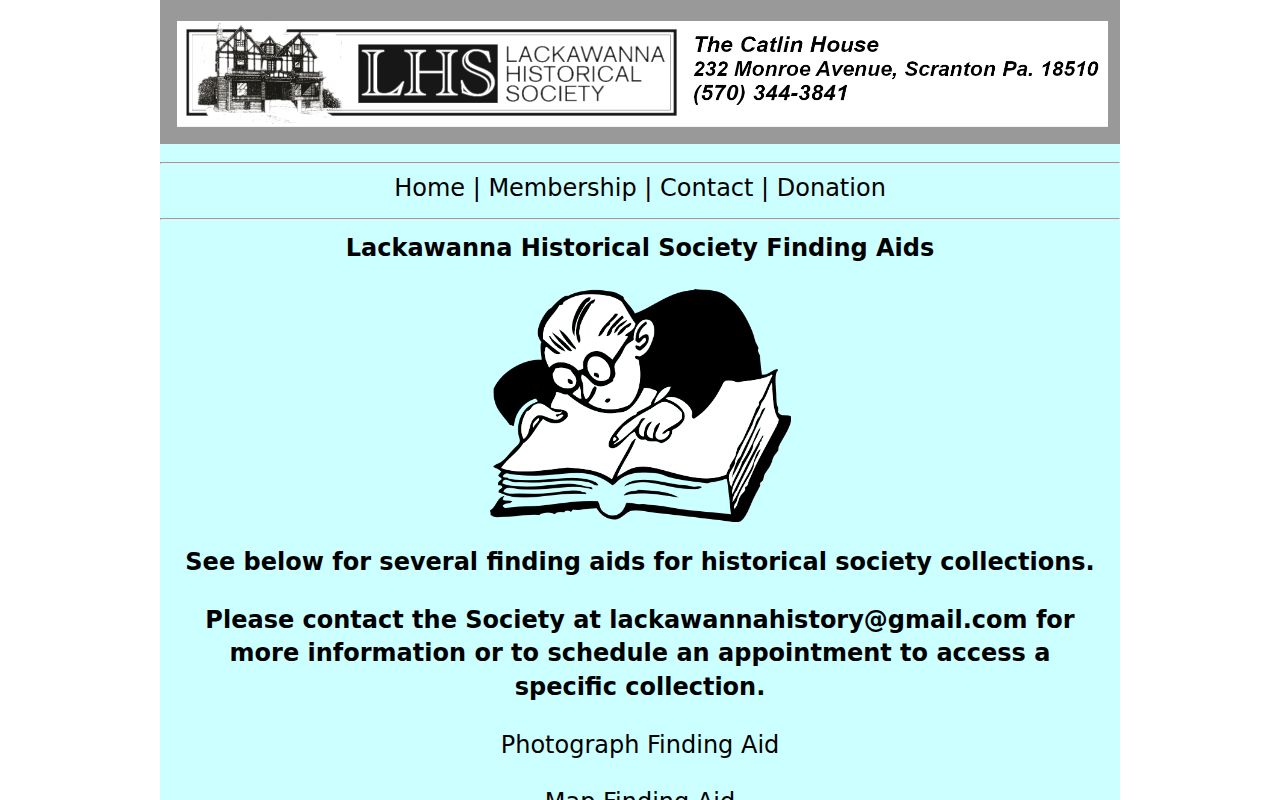
Pair a finding aid with a call or visit plan: nonmember use is listed at $5 per day, written research begins at $25 plus copying, and access or hours should be confirmed before travel. The University of Scranton's Local History Collection is an additional archive, with 1800-present coverage, selected digitized objects, and reading-room appointments.
A Scranton Directory Trail Can Cross the 1878 County Boundary
Lackawanna County was created from Luzerne County on August 13, 1878. That boundary change matters when a directory clue points to an earlier naturalization, deed, will, or family event within today's Scranton area: the related county record may be in Luzerne rather than in a Lackawanna index. The library guide specifically routes pre-1878 naturalization research into the Luzerne context and places Lackawanna deeds and wills from 1878 forward.
Do not substitute a guessed street-renumbering date for this documented jurisdiction change. No authoritative source located a single citywide Scranton renumbering year. Compare the old street wording with directory headings and historic maps, then ask Albright or the Historical Society for street-name or renumbering tables if the address form remains uncertain.
Trace a Scranton City Directory Household Across Years
A city-directory sequence works best as a dated comparison rather than a continuous biography. Follow the same name, spelling variants, or address across available volumes, and write down what changes before deciding what those changes mean. The practical objective is to build a source trail that another family researcher can revisit.
- Begin with the earliest confirmed name or address and ask Albright whether a regular city directory exists for that year.
- Transcribe the title, publisher, page, exact spelling, local address, and any notation only as it appears in the entry.
- Check the next available directory year, not an imagined annual sequence, for a move, a different spelling, or a changed household notation.
- If a street or reverse volume is available, use it to test the address clue and then return to the alphabetical entry for the printed context.
- Pair the directory evidence with a census enumeration, newspaper notice, local vital microfilm, or probate record that has its own date and custodian.
A name vanishing from a directory can reflect a move, death, changed spelling, incomplete coverage, or a volume that was never held. Local vital microfilm, newspapers, and county estate records can help test those possibilities, but each source answers a different question. That distinction makes the historical record useful without overstating what one printed line can prove.