
Scranton Resident Lookup Coverage
Official records answer narrow questions. The Lackawanna assessment and tax systems can connect an assessed owner or tax mailing contact to a parcel, while the Recorder connects parties to recorded instruments. The statewide court index can confirm that a named party appears in a dated case. Library and archive collections are stronger for a past household. A vital or probate record may document a family or estate relationship, subject to its access rules. Use more than one source before deciding that two same-named entries identify the same person.
| Record | What It Confirms | Where | Access |
|---|---|---|---|
| Assessment or tax record | Parcel, assessed owner, situs, and tax-mail association | Lackawanna Assessment Database and Tax Online | Public search paths; the assessment database had a maintenance notice during research. |
| Recorded instrument | A party role in a property or legal transaction | Lackawanna Recorder of Deeds | Index books cover 1878–1956 and Eagle documents cover 1957 to the present; copies follow county procedures. |
| Court docket | Named participant and dated proceeding | Pennsylvania UJS Case Search | Free public search, with excluded and delayed material. |
| Vital or probate record | Historical family, death, marriage, or estate connection | PA Department of Health, State Archives, Marriage Bureau, or Register of Wills | Eligibility, age thresholds, and copy rules vary by record. |
| Voter status | A limited, time-specific registration fact | Pennsylvania Voter Registration Status | Individual status route, not a public street roster. |
Choose a property source only when there is an address or parcel clue. Choose a court source when a case, county, or date can distinguish a name. For an older relative, pair an archival source with the custodian that holds the requested certificate or estate file. A record that cannot resolve a middle initial, role, location, or date range is a lead, not a conclusion.
Verify a Scranton Resident Record
A careful resident lookup begins with the least sensitive fact available and then tests it. With a name and address, the county assessment or tax route can identify a parcel and its record context. That does not establish who lives there. Add a Recorder document or a court docket only after checking the name spelling, date, county, and role. For a historic question, use a directory or newspaper in the same period, then ask the appropriate custodian about probate, vital, or court copies. Stop if two sources conflict rather than joining the records by name alone.
- Write down the complete name, any middle initial, the address form, and the time period being checked.
- When a property clue exists, search the county assessment or tax system for the parcel and keep the situs address separate from any mailing address.
- Search the Recorder with spelling variants, then compare the party role and document date with the parcel or address clue.
- Use UJS with the county, date range, case category, or participant details that make the name match more specific.
- Request the underlying document or certified copy from the custodian when a verified record is needed.
- Docket
- A docket is the court’s running case record, including its number, entries, participants, and dispositions.
- Index and image
- An index points to a record. An image is the underlying document or scan, which may require the office’s copy or account process.
- Certified copy
- A certified copy is issued by the record custodian with its official certification. It is different from a search result or informal printout.
Note: Keep the record number, date, and custodian with each result so a later correction or copy request can be directed to the right office.
Scranton Resident Lookup Court Dockets
UJS Case Search is a free statewide index for appellate cases, criminal Common Pleas cases, and Magisterial District Court civil, criminal, traffic, and non-traffic cases. Select Lackawanna County when that is known, then narrow with a participant name, docket or citation number, date filed, court office, docket type, category, or status. A Common Pleas docket begins with CP and the local judicial district is the 45th. The public screen also supports an Advanced Search area. A court hit confirms a proceeding, not an address or identity by itself.
A UJS result can provide a useful inventory to compare:
- participant and attorney names;
- docket number and, where applicable, a cross-court docket number;
- filed dates, docket entries, and dispositions;
- court-session information; and
- the county, court office, category, and status used to narrow the match.
Recent clerk entries can take time to appear. The search excludes juvenile, expunged, limited-access cases, and some Common Pleas civil records. It may also lack an electronic docket after a Magisterial District Court paper case has been destroyed under the retention schedule. For a paper file or certified copy, contact the relevant court office rather than treating a no-result as proof that no record exists.
For an older Lackawanna divorce record, the Clerk of Judicial Records is the county route from October 1885 forward. UJS directs a requester seeking a Magisterial District Court paper file to the corresponding court office, and complex requests can require a form. The Lackawanna County Law Library, in the courthouse basement, is a useful reference stop but is not the clerk’s copy office. Federal dockets belong in PACER, a separate system with its own account and fee policy.
Scranton Resident Lookup Vital Trails
Vital records need their own time line. Pennsylvania’s statewide system begins in 1906, while the Scranton Public Library holds city birth and death microfilm from 1878 through 1905. Birth records become public after 105 years and death records after 50 years. The State Archives holds original Pennsylvania births from 1906–1920 and deaths from 1906–1975, with non-certified copies available through its archival route. Closed certified records remain an eligibility-based Department of Health process rather than an open name search.
For a relationship question, use the route that owns the record. Lackawanna marriages from October 1885 and wills from 1878 are county routes; the Marriage Bureau and Register of Wills can explain their copy procedures. A qualifying adoptee or lineal descendant should use the Department of Health’s official adoption-information process, not a broad name search. If a year is uncertain, the Department’s multi-year search requires a separate application for each name variation and remains subject to eligibility.
The State Archives quotes $5 for a non-certified record, while the Department of Health lists $20 for a certified birth certificate and a $10 nonrefundable online service fee. The Department does not permit self-searching of its closed holdings. Mail, online, and in-person channels have different identity and eligibility requirements, so a requester should use the current agency instructions instead of assuming that an archive index grants access to a certified copy.
Scranton Resident Lookup Registration Limits
The state’s Voter Registration Status service is an official individual-status channel. It is not a public name-to-address directory or an all-voters-on-a-block search. A lawful result is best treated as a time-bound civic registration fact and checked against a separate property, court, or historical record. The public form’s complete live labels and matching rules were not captured in the research, so no unverified field list is presented here.
Pennsylvania’s voter-status service is shown in the official source capture below.
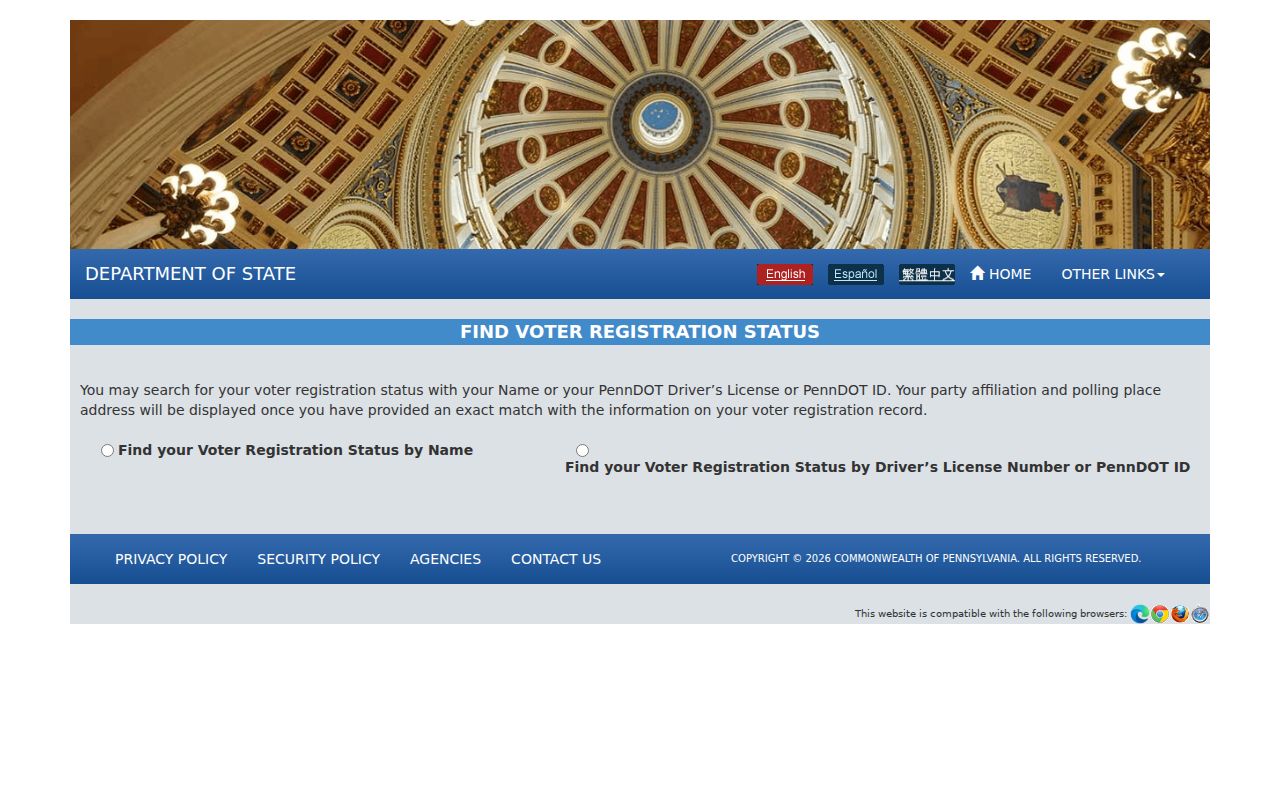
Registration information may change with list maintenance and is not evidence of a full household. Pennsylvania’s election rules also protect sensitive identifiers and protected addresses, while 25 Pa.C.S. § 1404 controls voter-file access and permitted use. The Lackawanna County Elections and Voter Registration office is the local route for a correction, precinct question, or narrowly defined election-record request.
Scranton Resident Lookup at Albright
For a former classmate, family line, or old address, Albright Memorial Library’s Local History collection gives a human research path that an online index cannot replace. Its Reference Department combines city directories, census microfilm, local vital microfilm, newspapers, maps, biographical and photo indexes, and research help. Give staff the name spelling, address, and years being sought, then ask whether a directory, newspaper, vertical file, or other local source covers that period. The historical volumes are better used beside modern verification records, not as proof that a person remains at an old address. The Scranton Directory Book gives the fuller directory-collection route.
Scranton Resident Lookup Address Geography
County parcel sources make an important local distinction. The situs, or location address, identifies the physical parcel. An owner mailing address identifies where tax correspondence is sent. They can be different, and neither proves that the owner or another person presently occupies the location. The assessment database offers property-owner, street-address, and parcel-ID paths, while Tax Online exposes the PIN, location address, owner name, mailing address, city, and ZIP. Use the parcel number when a shared street name or a same-name owner creates ambiguity.
Lawful Scranton Resident Lookup Limits
Safe at Home gives eligible Pennsylvania participants a substitute mailing address for covered state and local records. Under 23 Pa.C.S. § 6703, an application and actual address are confidential and exempt from Right-to-Know disclosure. A missing public result can therefore reflect confidentiality, a restriction, a name variation, a different jurisdiction, or limited index coverage. Correct an apparent government-record error with the originating custodian: assessment with Assessment, an instrument through the Recorder’s corrective process, court information with the court, voter changes with election administration, and vital matters with the Department of Health.
Lawful use. Use records for personal, lawful research. Pennsylvania law addresses stalking and harassment, and public information must never be used to track, threaten, intimidate, impersonate, or repeatedly contact another person.
The Pennsylvania DOC locator is a separate custody tool, not a resident lookup or a county-jail roster.
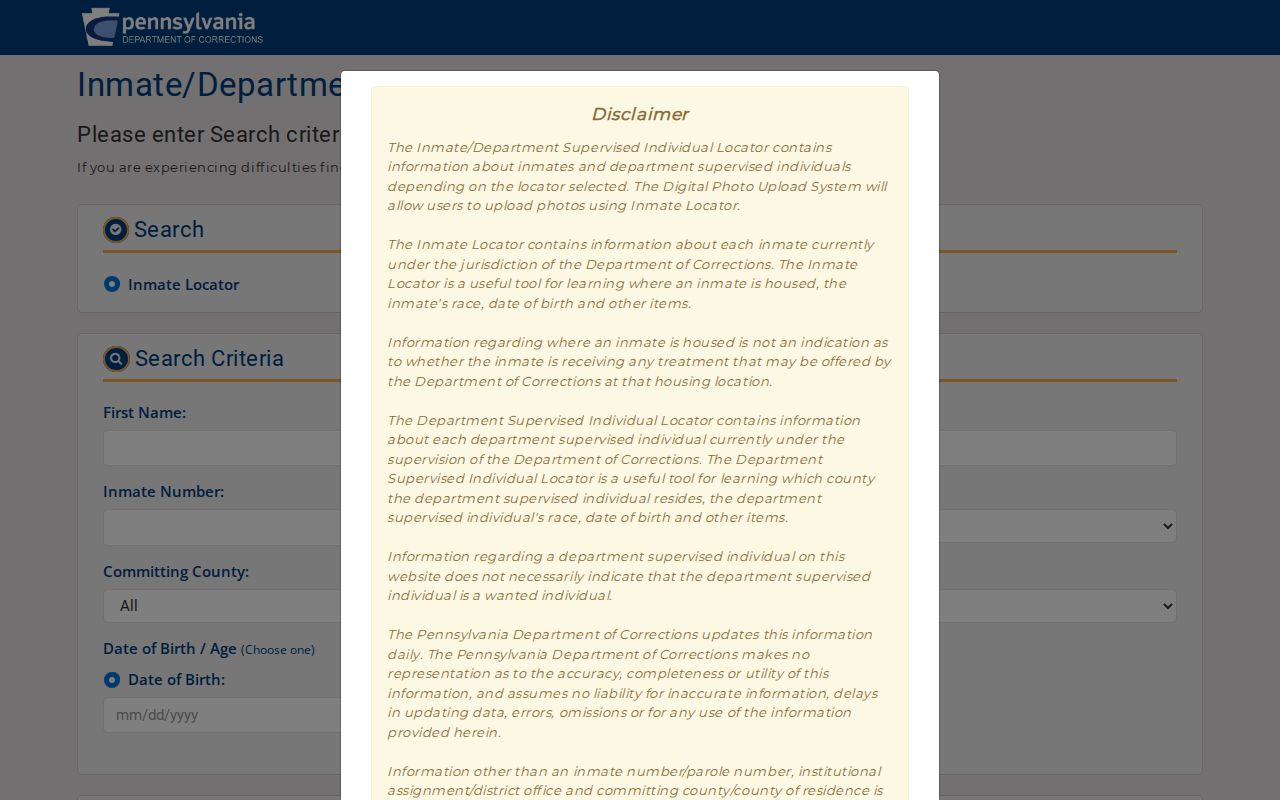
The locator covers people under Department of Corrections jurisdiction and excludes county and other-state custody. Start with a surname or identification number as the Department advises, and do not turn a custody result into a current-address claim. No official public Lackawanna County jail name roster was located in the research.
Pennsylvania State Police Megan’s Law search carries its own public-protection warning and source terms.
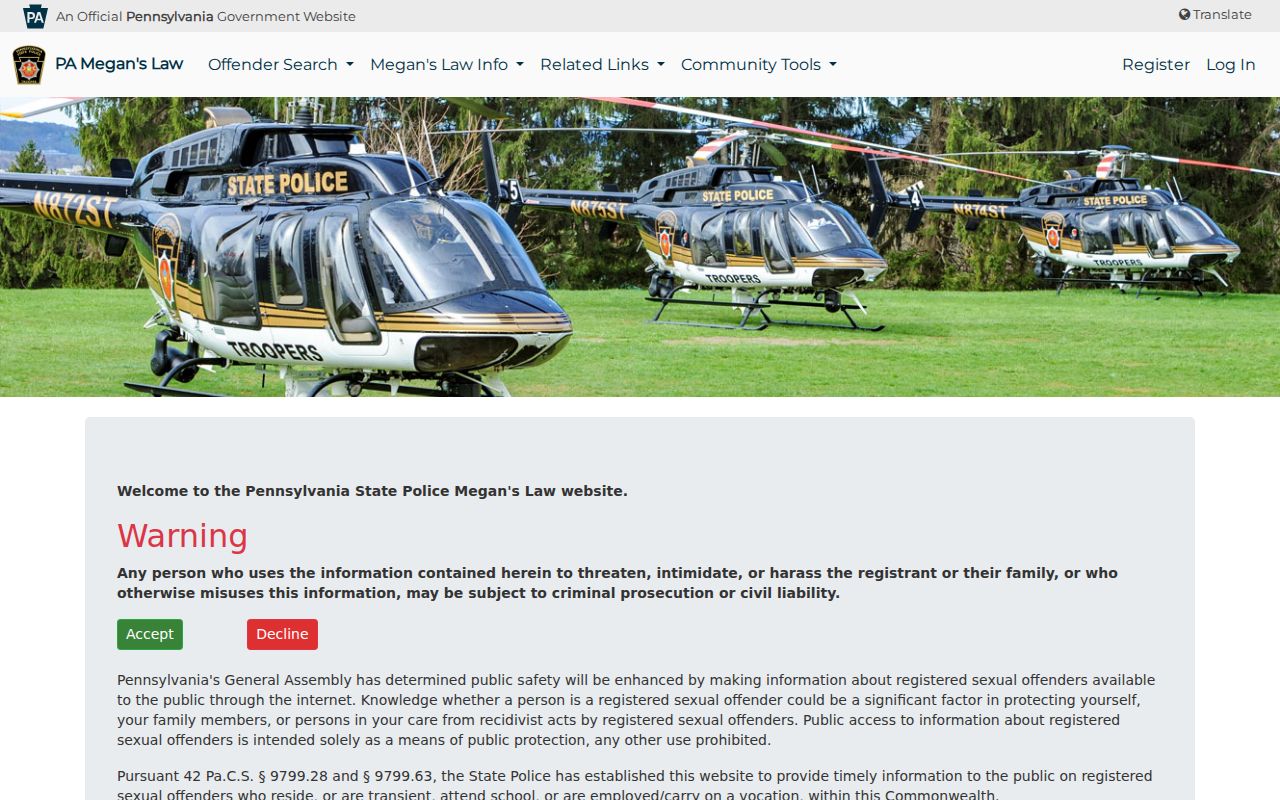
The registry says its information may be incomplete, outdated, or inaccurate, and fingerprint comparison is the only positive identity method. Its terms prohibit threatening, intimidating, harassing, or other misuse. Verify a concern through the proper public-safety channel rather than using any records source to target a person.